The Great Indian Reading Hijack
Consumerist industries have always followed us into the places we go to escape them.
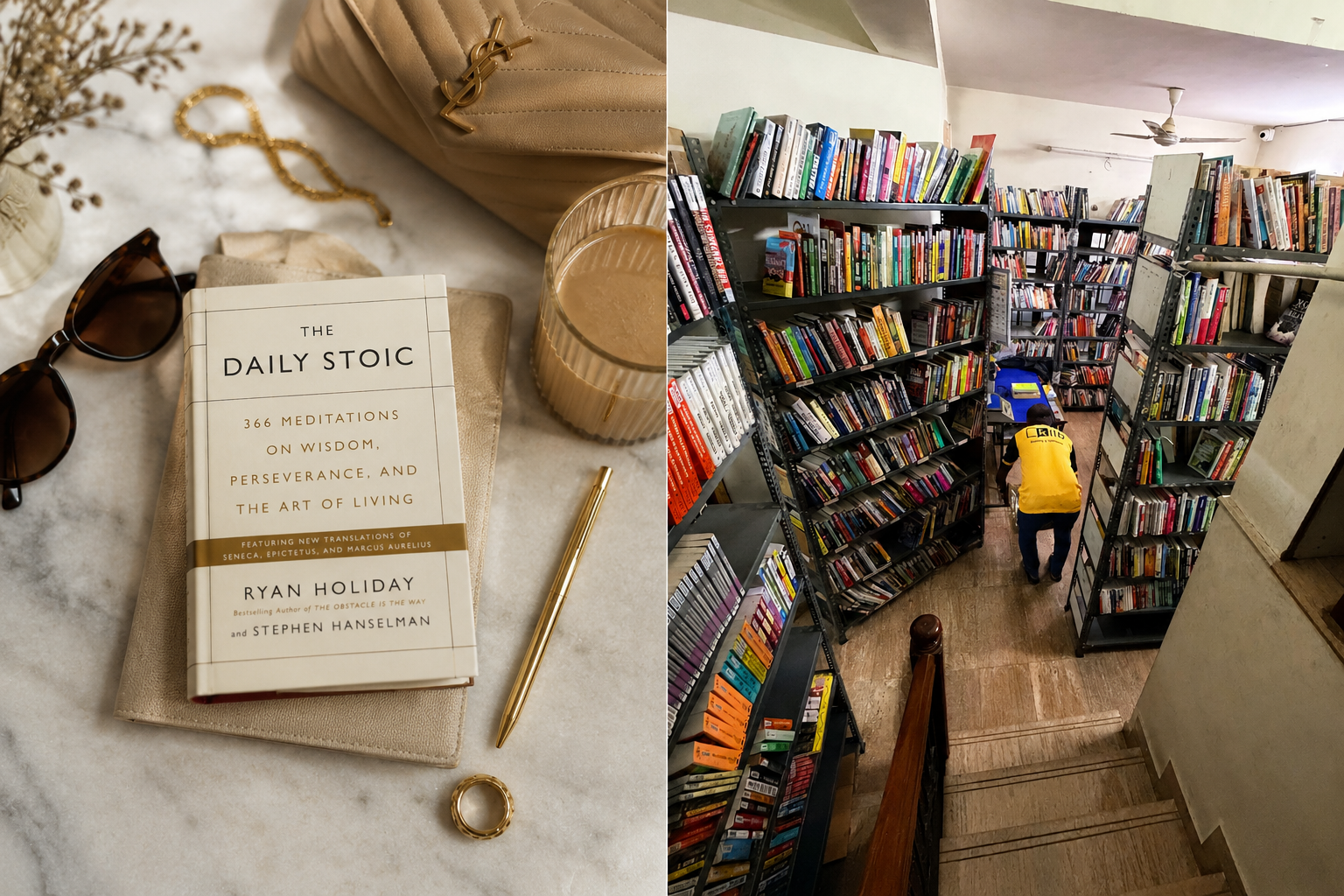
The clearest evidence is that you can buy books by the linear foot. Strand in New York runs the service for interior decorators, set designers and commercial spaces, curating collections by subject, binding, size and colour. Wonder Book in Maryland has done the same since the late nineties. One supplier sells hardcovers wrapped in matte art paper, chosen for dimensions rather than content, so a shelf reads as a clean block of colour. The books are real books. Whether anyone opens them is not part of the specification, because the product is a shelf, not a library.
That is the honest version of something happening more delicately everywhere else.
Miu Miu has staged a Literary Club in Milan every spring since 2024, directed by Miuccia Prada and held at the Circolo Filologico Milanese. This year’s edition built three days of programming around Annie Ernaux and Ama Ata Aidoo. Saint Laurent opened a bookshop on Rue de Grenelle in Paris stocking rare titles and out-of-print records, and has been publishing under its own imprint since 2019. Meanwhile the sequence that got us here is familiar. Celebrity book clubs became influencer reviews. Influencer reviews became a genuine commercial force, with Nielsen crediting BookTok for pushing genre fiction onto bestseller lists across several markets. Where attention goes, money follows. The money has arrived.
Some of this is worth defending, and in India the defence is easy to make.
The National Book Trust’s youth readership survey, conducted in 2009, found around 83 million young Indians identifying as readers, but only about a quarter of them reading for pleasure rather than for exams or work. Nielsen’s 2015 market study found school and higher education books accounting for well over ninety per cent of the trade. Both figures are dated now, and nobody has published anything better at that scale since, which tells its own story. In the Indian mainstream, reading has largely been something you do to qualify, whatever the regional literary cultures have quietly sustained alongside it. A culture that makes a novel desirable, rather than mandatory, is not nothing.
But the object being sold is rarely the book. It is the impression of having read it.
This is not a modern failing. Two thousand years ago Seneca was annoyed by exactly this. In On Tranquillity of Mind he objects to people who own more volumes than they could read the titles of in a lifetime, and dismisses libraries assembled as monuments to a household’s wealth rather than its thinking. He was not diagnosing a trend. He was describing a permanent human habit.
What has changed is the price. Assembling a shelf that signalled learning once took decades. Now it takes a photograph.
Appearing well-read has always cost less than becoming it.
Notice, too, the verb we have settled on. We talk about consuming books, which is exactly backwards. You don’t consume a book. You engage with it. You argue with it. You return to a sentence you never finished thinking about. You carry an idea around for a week and find it has quietly rearranged something you believed on Monday.
Reading asks for the one thing most consumption is designed to avoid, which is attention. It asks you to slow down without producing anything, to spend time somewhere that cannot be counted in likes or impressions or conversions. That is not a small ask in the current environment, and it is why reading can feel almost adversarial now.
We see the same substitution inside companies.
The workplace version is a shelf in reception. A book handed out at induction. A photograph of the library on the careers page, and a line about a learning culture in the annual report. None of that is reading. It is the image of a reading culture, which is a considerably easier thing to buy and a considerably cheaper one to maintain. Nobody has to change how they spend a Tuesday.
The real signal is behaviour. Who borrows. Who returns. Who comes back for a second book without being prompted. Those numbers are unglamorous and they are the only ones that cannot be staged, which is precisely why they are worth watching. A shelf tells you what a company wanted to look like. A borrowing record tells you what its people actually did.
So yes, let books be desirable again. Let the fashion houses host their festivals. If a campaign photograph sends one more person to a bookshop, the trade is a good one.
But the point of reading was never that it made us look cultured. It was that, for a while, it made us look at the world differently.
References
Strand Bookstore, Books by the Foot. Custom book collections and rentals assembled for interior decorators, set designers, commercial spaces and personal libraries, curated by subject, style, binding, size and colour. strandbooks.com/books-by-the-foot.html Strand Books
Wonder Book, About Books by the Foot. Books sold in bulk as decoration, props and instant libraries, a service featured by the New York Times in 2011. booksbythefoot.com/about Books by the Foot
Juniper Custom, Books by the Foot collection. Paper-wrapped hardcovers selected for size rather than content. junipercustom.com Juniper Custom
Miu Miu, Literary Club 2026. “Politics of Desire”, 22 to 24 April 2026 at Circolo Filologico Milanese, directed by Miuccia Prada, in its fourth iteration, built around Annie Ernaux and Ama Ata Aidoo. miumiu.com Miu Miu
Miu Miu, Literary Club 2024. The inaugural edition, “Writing Life”, centred on Sibilla Aleramo and Alba De Céspedes. miumiu.com Miu Miu
WWD, February 2024. Saint Laurent Babylone on Rue de Grenelle, Paris, stocking rare books and out-of-print records curated by Anthony Vaccarello, alongside titles from the Rive Droite Editions imprint established in 2019. wwd.com WWD
NielsenIQ, International Book Markets 2025. BookTok credited with driving authors and titles to bestseller status across numerous territories. nielseniq.com NielsenIQ
National Book Trust, National Youth Readership Survey, 2009, as reported in Business Standard. Roughly 83 million young Indians identified as readers, of whom about a quarter read for pleasure rather than professional reasons. business-standard.com Business Standard
Nielsen, India Book Market Report, 2015, as reported in Publishing Perspectives. K-12 school books estimated at around 71 per cent of the market, with higher education accounting for a further 22 per cent. publishingperspectives.com Publishing Perspectives
Seneca, On Tranquillity of Mind, 9.4 to 9.5, trans. J.W. Basore. He questions the use of countless books whose titles their owners could scarcely read through in a lifetime, and argues the reader is burdened rather than instructed by the mass of them. asu.edu/lib/jod/texts/seneca.english.html asu